Key Points
- More than 10,000 homes remain without electricity across southern England and Wales following the landfall of Storm Austen.
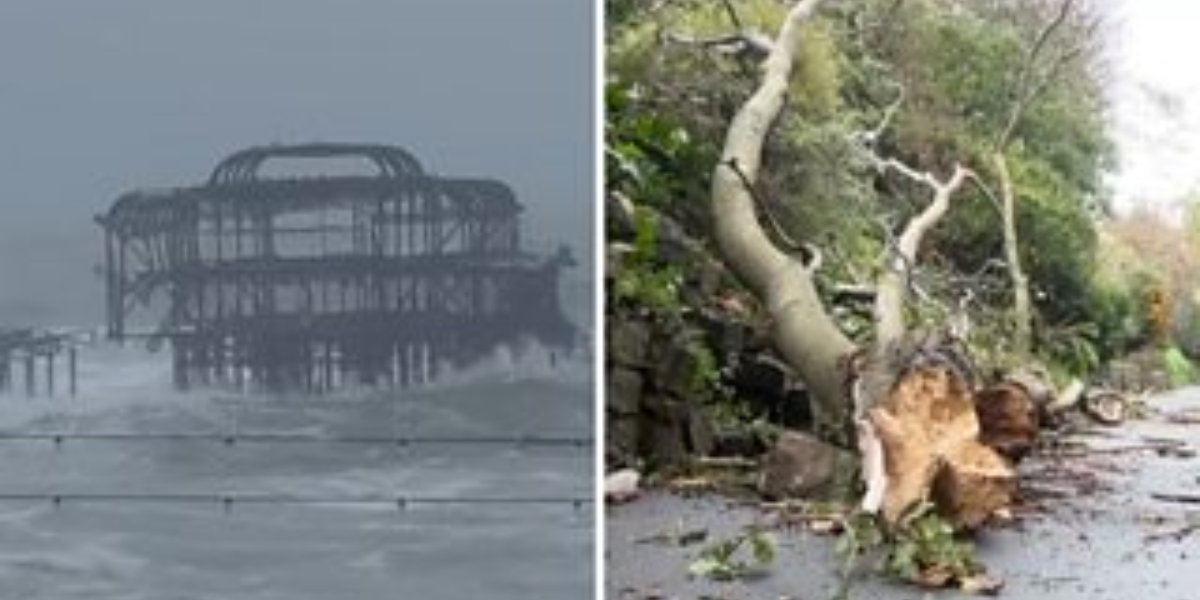
- In Brighton, a section of the derelict 1866 West Pier collapsed into the ocean due to violent wave action.
- Cross-Channel ferries, rail services, and flights at Jersey, Exeter, and Newquay airports faced cancellations, closures, or severe delays.
- Closure of maritime supply routes has led to predicted fresh food shortages across Guernsey and Jersey.
- The Met Office has issued an amber weather warning for Storm Boelo, bringing anticipated gusts up to 80 mph across Scotland, northern England, and Northern Ireland.
- The extreme weather coincides with a UK government release advising households to keep a three-day supply of emergency food and water.
London (Britain Post News) october 24, 2026 – Storm Austen has brought widespread infrastructure disruption, power outages, and transport cancellations across southern England, Wales, and the Channel Islands, with engineers working to restore electricity to thousands of affected households. The first named storm of the season tracked eastwards after making overnight landfall in the south-west, prompting school closures, emergency evacuations, and structural destruction along the southern coastline. Met Office forecasters have warned that a second system, Storm Boelo, is set to deliver further damaging winds and torrential rain across northern regions of the United Kingdom over the weekend.
- Key Points
- What Immediate Damage Has Storm Austen Caused Across the UK?
- How Has Transport Infrastructure Been Affected by the Storm?
- Why Are Supply Chains in the Channel Islands Facing Disruptions?
- What Extreme Weather Is Forecast for Storm Boelo This Weekend?
- How Does This Storm Relate to National Emergency Guidelines?
- Background of Storm Austen and UK Extreme Weather Patterns
- Prediction: How Will This Development Affect UK Residents and Businesses?
What Immediate Damage Has Storm Austen Caused Across the UK?
Storm Austen made landfall in the south-west overnight before tracking eastwards across southern England and Wales, leaving more than 10,000 homes without electrical power. According to operational figures released by the National Grid, utility engineers have successfully restored power to more than 60,000 properties since the storm system initiated.
The storm generated peak wind gusts of up to 84 mph (135 km/h) on the island of Jersey, while Paul Aked, head of Jersey Met, recorded gusts reaching 76 mph (122 km/h) in Guernsey, describing the conditions as equivalent to a severe force nine gale. Residents speaking to local media reported violent wind noise rattling residential properties throughout the night.
The violent weather conditions caused significant physical destruction along the Sussex coastline. In Brighton, a prominent portion of the historic West Pier—an abandoned seaside structure originally opened in 1866—collapsed into the sea after being continually battered by massive swell. As observed by local resident Stephen Royle, who lives opposite the site and filmed the collapse, the incoming waves were described as “enormous,” with Royle expressing shock at the extent of the structural framework lost to the water.
How Has Transport Infrastructure Been Affected by the Storm?
Travel networks across southern England and the Channel Islands have experienced widespread disruption caused by fallen trees blocking railway corridors and highways. National Rail advised passengers that train services across numerous routes were required to operate at reduced speeds, with multiple rail operators warning that scheduling delays and cancellations would persist throughout the weekend.
Maritime travel between the United Kingdom and France faced partial cancellation as cross-Channel ferry operators suspended sailings due to sea state conditions. Aviation schedules were similarly impacted:
- Jersey Airport: Suspended all flight operations, confirming that aircraft movements would not resume until at least 17:00 BST.
- Cornwall Airport Newquay: Urged passengers to verify flight statuses directly with airlines prior to traveling to the terminal.
- Exeter Airport: Departure terminals logged multiple flight cancellations throughout the disruption.
The severe conditions prompted preventive evacuations in coastal areas prior to the heaviest weather on Thursday afternoon. Families residing at a holiday park in Perranporth, Cornwall, were moved to alternative accommodation. Evacuated visitor Hannah Dawson-Turk described the conditions, stating that during the night prior to evacuation, the wind intensity made it sound as though their caravan structure was going to be ripped apart, adding that waves off the coast remained exceptionally large.
Educational institutions were also affected, with all schools across Jersey and Guernsey closing for the duration of the storm, while select schools in Cornwall implemented delayed start times or full closures.
Why Are Supply Chains in the Channel Islands Facing Disruptions?
The prolonged suspension of freight and passenger ferry services has raised immediate concerns regarding grocery inventory levels across the Channel Islands. Mark Cox, chief executive officer of the local Co-op retail network, confirmed that fresh food shortages are expected across Jersey and Guernsey in the coming days.
Addressing the supply constraints, Mark Cox stated: “It’s rare we get this level of disruption to storms backing up so quickly and probably a little bit more heavier than what we’ve had to deal with in the past.” The consecutive timing of weather systems has limited the window available for cargo vessels to restock island distribution centres.
What Extreme Weather Is Forecast for Storm Boelo This Weekend?
As Storm Austen moves eastward, meteorologists have confirmed that the UK will remain subject to severe weather as a secondary named weather system, Storm Boelo, follows closely behind.
The Met Office has implemented an amber weather warning for wind, active from 21:00 BST on Saturday to 21:00 BST on Sunday. The amber warning zone encompasses:
- Large regions of Scotland (excluding the Northern Isles)
- The northernmost border regions of England
- The northern coastline of Northern Ireland
Within the amber warning zone, meteorologists project widespread gusts of 60 to 70 mph, with exposed coastal headlands potentially registering peak winds up to 80 mph. Wind conditions funneling through the Central Lowlands of Scotland are anticipated to generate specific transport and infrastructure disruption.
Supplementary yellow weather warnings for wind cover Orkney, the remainder of Northern Ireland, and broader areas of northern England, where gusts between 55 and 75 mph remain possible. Alongside wind risks, heavy and persistent rainfall across Saturday is expected to create hazardous driving conditions due to surface water spray, raising the likelihood of localized flooding.
The Met Office has issued formal public safety advice, instructing motorists to exercise caution, advising residents to secure loose outdoor items such as domestic bins and trampolines, and urging individuals in coastal zones to remain indoors where possible.
How Does This Storm Relate to National Emergency Guidelines?
The onset of severe autumn weather coincides with updated emergency response guidance published by the UK government. Official recommendations advise domestic households to maintain a minimum three-day reserve of bottled water and non-perishable tinned food to build resilience against potential national crises, including severe weather events, energy supply failures, or cyber incidents.
Prime Minister Andy Burnham addressed the timing of the guidance, stating: “It’s not about panic buying… It’s about just taking sensible measures to have enough in the house to tide you over should there be a difficult situation.”
The government’s push for household preparedness follows recent analysis by the National Audit Office, which issued a warning last month highlighting vulnerabilities within Britain’s food supply network resulting from the combined impacts of climate volatility and potential supply chain disruptions.
Background of Storm Austen and UK Extreme Weather Patterns
Named storm systems affecting the British Isles are officially designated by the national meteorological services of the UK (Met Office), Ireland (Met Éireann), and the Netherlands (KNMI) to enhance public safety communications during severe weather events. Storm Austen represents the first official named storm of the current seasonal period, signifying the transition into period active North Atlantic low-pressure systems.
The structural failure of Brighton’s West Pier during Storm Austen highlights the ongoing degradation of historic maritime infrastructure subject to coastal erosion and unmaintained marine exposure. Opened in 1866 during the peak of Victorian seaside tourism, the Grade I-listed pier was permanently closed to the public in 1975 due to safety concerns and declining revenue. Subsequent structural fires in 2003 and successive winter gales have progressively destroyed the iron framework, leaving the ruined skeleton as a recognized local landmark that remains vulnerable to high-energy wave impacts during spring tides and autumn gales.
Prediction: How Will This Development Affect UK Residents and Businesses?
The arrival of Storm Austen and the rapid follow-on of Storm Boelo indicate an increasingly compressed window between severe weather events, presenting immediate and medium-term operational challenges for several key sectors:
- Domestic Energy Consumers and Utility Providers: With over 10,000 households currently disconnected and further 80 mph winds forecast under the amber warning for Storm Boelo, utility companies face prolonged restoration timelines. Additional structural damage to overhead power lines is likely to produce secondary outages across northern regions, testing grid repair capacity.
- Transportation Networks and Logistics Operators: Rail freight and passenger services are projected to face cumulative delays through the weekend due to speed restrictions and debris clearance. Flight backlogs at regional airports will require operational re-balancing, while cross-Channel and inter-island maritime logistics will experience multi-day schedule adjustments to clear cargo backlogs.
- Retail Supply Networks and Consumers: Island communities in Jersey and Guernsey will experience acute shelf shortages of fresh produce over the coming days until ferry sailings normalize. For mainland consumers, the combined impact of severe weather events and government emergency stocking advice may lead to localized spikes in demand for stable shelf-goods and bottled water, placing temporary demand pressures on supermarket distribution hubs.